
Ready-to-Move vs New Launch Properties in Greater Noida West — 2026


For homebuyers and property investors, the choice between ready-to-move and new-launch properties in Greater Noida West is a critical one. Your choice will depend on when you need to take possession, how you will finance the purchase, whether you want to visit the actual flat and how comfortable you are with the uncertainty of construction.
Buyers who want to move sooner and see the home in person might prefer a home that’s ready to move in. New-launch properties may be right for buyers with flexible timelines who are comfortable assessing the developer, project documents, payment schedule and construction risks. Neither option is necessarily cheaper, safer or a better investment.
Before you book the flat, compare the total cost, terms of possession, approvals, disclosures of the project and your financial readiness. This guide is for you to compare both options in Greater Noida West.
If you are still weighing up the completed homes with the ones that are still under construction, Shiva Associates, a trusted property dealers in Greater Noida, suggests you check out our guide to ready-to-move vs under-construction property in Greater Noida to know the key differences, possession timelines and factors to consider before taking an informed property decision.
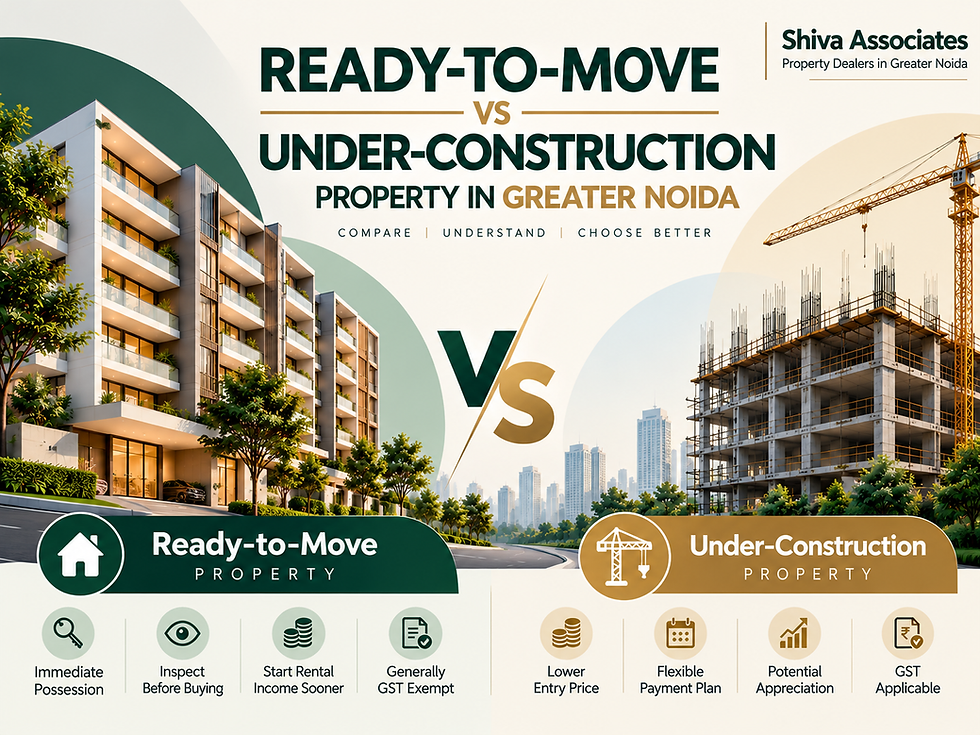
Ready-to-Move vs New Launch Properties: What Is the Difference?
A ready-to-move property is a completed residential unit which can be available for possession or resale depending on its legal and handover status. Buyers usually have the chance to view the actual flat, the building, the common areas and the environment surrounding them before deciding.
The newly launched property is a part of a newly launched residential project. Depending on the stage of construction, the flat may not even be a finished unit. Buyers should assess approved plans, specifications, project disclosures, construction progress and contractual terms of possession.
The main difference is the trade-off between immediacy of usability and uncertainty of future delivery.
Comparison factor | Ready-to-move property | New-launch property |
Possession | May be available sooner, subject to verification | Depends on construction progress and contractual terms |
Physical inspection | An actual apartment can generally be inspected | Assessment may rely on plans, specifications, and site visits |
Payment structure | Depends on the seller, transaction, and financing | Depends on the developer's payment plan |
Construction uncertainty | Generally lower for a completed and verified unit | Higher when substantial construction remains |
Amenities | Existing facilities can be inspected where available | Some facilities may still be under development |
Rental potential | Renting may be possible sooner if legally available | Usually depends on completion and possession |
Additional expenses | May include transfer, maintenance, repair, and transaction costs | May include instalments, applicable taxes, and other contractual charges |
Investment outcome | Depends on market conditions and property characteristics | Depends on market conditions, project execution, and property characteristics |
Use this comparison as a starting point. The condition, documentation, location, price, and contractual terms of the individual property matter more than the category alone.
What Are the Advantages of Ready-to-Move Properties in Greater Noida West?
1. Inspect the Actual Apartment Before Buying
One of the most beneficial advantages of a completed property is the possibility of seeing the real unit.
You can judge room sizes, ventilation, natural light, fittings, flooring, visible build quality, views and general layout. You can also check the building entrance, lifts, common areas, parking arrangements and the amenities available.
During a visit, consider checking:
Visible damage, moisture or signs of seepage.
Water supply and drainage, electrical fittings and ventilation.
Lift condition, maintenance of common areas and security arrangements.
Parking allocation and building access.
Noise, road access and facilities nearby.
A physical inspection does not determine legal ownership and does not reveal all structural or technical problems. Where appropriate, consider professional inspection and verification of documents by an independent party.
2. Plan Your Move With Greater Clarity
If you’re a buyer who needs to relocate due to work, family needs, education or other personal reasons, a completed flat may be a good option.
But it must not be assumed that every completed building is available at once for lawful occupation. Check applicable completion and occupancy documents, possession status, outstanding dues and handover requirements for the property.
If you are renting now, compare the cost of continuing to rent versus the expected cost of buying and moving into the property. This will allow you to measure the financial effect of your timeline.
3. Evaluate the Existing Neighbourhood
Now that the residential development is complete, you can see what the area looks like.
If you can, visit the property at different times. Assess access roads, traffic conditions, nearby shops, public transport, schools, healthcare facilities and the general upkeep of the development.
Don't just take the word of the advertised proposed infrastructure or amenities. Distinguish between facilities that are operating, under construction and only proposed.
4. Explore Rental Possibilities Earlier
If the unit is tenant-friendly and legally habitable, a ready-to-move-in property may allow you Also, with a ready-to-move-in property, you may have the chance to see how it is to rent before a project is finished, if the unit is tenantable and legally habitable.
Before adding rent to your financial plan, research similar rental listings, likely tenant demand, maintenance costs, vacancy times and other ownership expenses.
Admitted rents are not actually achieved rents, and a property may be vacant. View rental income as a possibility, not a guarantee.
What Are the Advantages of New-Launch Properties?
1. Compare Available Configurations and Floor Plans
Availability may vary for new-launch projects in terms of apartment configurations, unit sizes, floors, orientations and layouts.
Compare Usable Space, Carpet Area, Bedroom Sizes, Ventilation, Storage, Balcony Arrangement and Suitability for your Household. Look at the proper plans and written specifications, not just the show apartments or the marketing images.
A nice-looking show flat may have furniture or finishes that are not included in the standard package. Confirm in writing the inclusions and exclusions.
2. Evaluate Project-Specific Launch Offers
Some of the projects may have introductory prices, limited period schemes and other booking incentives. These offers should be weighed against the overall cost of the property.
Before comparing two apartments, it is important to get a cost break-up in writing for the base cost, taxes applicable, parking, maintenance deposits, club or amenity charges, registration expenses and other payments as per the contract.
Just because something starts out cheaper doesn’t mean it will end up cheaper. Compare similar properties on location, specifications, construction stage, unit size and possession terms.
3. Understand the Payment Schedule
New-launch projects may have construction-linked, time-linked or other payment schedules. The arrangement is at the discretion of the developer, the project and the sale agreement.
Before you book, check:
The size of the booking and the initial payment requirements.
The timing and basis of future instalments.
The conditions for loan disbursement.
Applicable charges, taxes, and other contractual payments.
Terms & Conditions for Loan Disbursement. or cancelled.
The time line of possession and the contract provisions relating to delays.
Your payment plan should be in line with your income, savings, borrowing capacity and anticipated financial commitments. Don’t go for a property simply because of the size of the first booking amount.
4. Consider Long-Term Housing and Investment Objectives
Buyers who do not need immediate possession and are prepared to evaluate the developer’s ability to deliver, the pace of the project, and the contractual commitments may be a good fit for a project that is just starting.
But the potential for future appreciation depends on several factors, including the location, the property specifications, the demand and supply in the market, the financing conditions and successful project delivery.
No launch price or location story guarantees appreciation, resale demand or a specific investment return.
Which Is Better for First-Time Buyers: Ready-to-Move or New Launch?
There’s not one answer for all first-time buyers. The decision has to start by looking at your actual housing needs and financial situation.
Ready-to-Move May Suit You If:
You'll have to move into the home pretty soon.
You want to see the actual flat before you buy.
You enjoy assessing existing facilities and the condition of the neighbourhood.
You want more clarity on the physical condition of the property at the present time.
You have checked the total cost of purchase against your available funds and loan eligibility.
A New Launch May Suit You If:
There’s no set timeline for your possession.
You have assessed the payment schedule and can meet the future instalments.
You are comfortable assessing construction and delivery risks.
You have reviewed the project registration, disclosures and applicable approvals.
You have compared total cost with appropriate alternatives completed.
A Practical Decision Example
Say you have two buyers looking at apartments with similar asking prices.
Buyer A has to move in the next few months. For this buyer, it may be more practical to buy a flat that is already finished, with verified documents and satisfactory inspection results, even if the starting price is higher.
Buyer B doesn’t need immediate possession and can work with the payment schedule during construction. If you're comfortable with the project documentation, the developer's track record, the construction plan and the terms of the contract, you may consider a new-launch project for evaluation.
These examples show how the decision can change depending on individual circumstances. These are not predictions of the performance of a particular property.
How to Compare the Total Cost Before Booking
The advertised price is only part of the purchase of a property. Look at the total cost of ownership for each option.
Cost consideration | Ready-to-move property | New-launch property |
Purchase price | Agreed resale or developer price | Applicable project price |
Taxes and registration | Verify applicable charges | Verify applicable charges |
Maintenance and deposits | Check outstanding dues and deposits | Review applicable deposits and payment terms |
Repairs and interiors | Assess the actual unit's condition | Review specifications and additional interior costs |
Loan expenses | Check eligibility and financing terms | Check eligibility, disbursement, and instalment requirements |
Waiting-period costs | Usually depends on when possession is possible | Consider rent and other expenses while waiting |
Other charges | Confirm all seller and transaction costs | Confirm all developer and transaction costs |
Get written cost sheets to make a meaningful comparison and find out what charges are included, excluded, refundable or payable later.
Also take into account the effect of your interest payments, current rent, emergency fund and other household commitments. Your financial situation may change, but you should still be able to afford the right decision.
What Should You Verify Before Buying a Property in Greater Noida West?
It is important to verify the property, whether it is a completed flat or a new launch project. The checks vary according to the property type, ownership structure, project status and transaction.
1. Check UP RERA Registration Where Applicable
For projects requiring registration, check the project details on the official UP RERA website.
Look at the registration details, promoter details, stage of the project, declared timelines and available project disclosures. Check the status of the specific project and phase, not just the developer's name or marketing brochure.
RERA registration is a major verification step, but it does not guarantee timely possession, investment returns or absence of any legal issue.
If you are planning to buy a residential property, read our detailed guide on what RERA is and why you must check it in Greater Noida to understand project registration, important disclosures, and the checks to consider before booking.
2. Review the Relevant Approvals and Property Documents
The documents you’ll need will depend on the type of transaction. These may include relevant sanctioned plans, project approvals, title-related records, sale or lease documents, completion or occupancy documents where applicable and the agreement governing the purchase.
For relevant building-plan or completion checks, please check with the relevant authority and their official verification resources (including the Greater Noida Authority building-plan portal, if applicable).
For a completed property and a new-launch project, the verification steps may differ. If the ownership or approval position is not clear, get independent legal advice.
3. Review the Developer's Track Record
For a new-launch project, check the developer’s completed projects, delivery history, construction quality, maintenance arrangements, and project information available to the public.
If possible, visit completed developments and speak to residents. Promotional statements on delivery, facilities, and future development should be taken as claims to be verified.
A developer's track record can be useful context, but it can't guarantee the outcome of a new project. Choosing the right property also involves evaluating the experience, transparency, and services of the professional assisting you. Read our guide on how to choose a property consultant in Greater Noida to understand what to consider when selecting a property consultant for your buying journey.
4. Verify Possession and Handover Conditions
If it is a ready-to-move property, find out if possession can really be handed over and if the necessary papers and handover conditions are in place.
If it is a new-launch property, check the possession date mentioned, the terms and conditions, the payment plan and the provisions that apply in case of delay or other breaches.
Before signing or paying a booking amount, ensure you understand the agreement.
5. Confirm Outstanding Dues and Transaction Conditions
If you are buying a resale property, verify applicable property taxes, maintenance charges, utility dues, loan or encumbrance information, and other obligations relevant to the transaction.
For a developer sale check the cost sheet, payment terms, cancellation terms and the method to close the deal.
Appropriate records should support the seller or developer’s statements wherever possible.
6. Understand Where Your Payment Is Going
Read the payment instructions and comply with applicable project and contract requirements. The UP RERA official portal provides guidance on payment and project information.
Keep receipts, signed documents, written correspondence and payment records. Don’t send money because someone verbally assures you or pressures you to book now.
Common Mistakes to Avoid When Comparing Property Options
Choosing Only on the Basis of Price
Two apartments with similar advertised prices may have major differences in usable area, location, condition, amenities, payment obligations and total cost.
Assuming a New Launch Is Always a Better Investment
Early pricing does not assure future appreciation or that a resale will be profitable. Assess the project and financial commitment on their merits.
Assuming a Completed Apartment Is Risk-Free
Even a complete unit may have documentation gaps, outstanding dues, maintenance problems, or ownership issues. Check the right papers and the physical condition.
Ignoring the Cost of Waiting
Construction-period rent, loan interest, installments and other household expenses can impact the affordability of a new-launch project.
Relying Entirely on Brochures and Verbal Promises
Review specifications, approvals, contractual terms, and official project disclosures. Ask for clarification in writing if key information is ambiguous.
Booking Without Reviewing the Agreement
Read the payment schedule and the terms of possession, cancellation provisions, other charges and other obligations before you sign or transfer money.
Frequently Asked Questions
Is Ready-to-Move Property Better Than a New-Launch Property?
Neither one is better in itself. Buyers looking for early possession and a physical property can opt for ready-to-move properties. For buyers comfortable with construction and delivery risks and flexible timelines, new-launch projects might be appealing.
Are New-Launch Properties Cheaper Than Ready-to-Move Flats?
Not really. Pricing is specific to the project, location, size, specifications, construction stage and payment terms. Don’t just look at introductory offers or advertised prices; compare the full cost.
Can I Earn Rental Income From a New-Launch Property Immediately?
Rental income is normally dependent upon completion, possession, legal availability for occupation and demand from tenants. As a general rule, a new-launch property that is still under construction will not be able to provide immediate rental occupancy. No guarantee of actual income.
What Should I Check Before Booking a New-Launch Flat?
Check the relevant RERA registration, project disclosures, approvals, developer information, payment schedule, possession terms, agreement terms and total cost. Seek independent legal advice where necessary.
What Should I Check Before Buying a Ready-to-Move Flat?
Before you pay or sign, inspect the actual flat, check the relevant ownership and transaction documents, verify applicable completion or occupancy records, check outstanding dues and understand the handover conditions.
Does RERA Registration Guarantee Timely Possession?
No. RERA has laid down legal obligations and mechanisms to deal with certain violations and disputes. However, registration alone does not ensure that a project will be delivered on time.
How Do I Choose a Property in Greater Noida West?
Know your budget, configuration you want, location requirements, possession time line and financing capacity. Compare the specific features, read the relevant documentation and consider the overall price before you commit.
Conclusion: Ready-to-Move vs New Launch Properties in Greater Noida West — 2026
Ready-to-move or new-launch properties in Greater Noida West: Which one is right for you? The right choice depends on your personal requirements, budget, possession timeline and willingness to deal with uncertainty.
In case you want to see the actual flat and want to move in sooner, a ready-to-move property would be a better fit. If you’re flexible with your timing and have done your homework on the project documentation, developer info, payment schedule and construction risks, then a new-launch project could be an option to consider.
Examine the relevant records, understand the agreement and do not make decisions based solely on promotional offers or expected returns. Compare the total cost before booking either option.
Explore Property Options with Shiva Associates
Looking for residential property in Greater Noida West? As property dealers in Greater Noida, Shiva Associates can help you explore properties available as per your budget, preferred configuration, location requirements and possession timeline.
Shiva Associates—Your Property Dealer in Greater Noida West.
Call / WhatsApp: +91 99990 90047
Office: 9th Floor, Tradex Tower-II, Alpha-I Commercial Belt, Block E, Alpha I, Greater Noida, Uttar Pradesh – 201310
Website: https://www.shivaassociates.com
Disclaimer: This article is for general informational purposes only and does not constitute legal, financial, or investment advice. Property availability, pricing, possession status, applicable charges, rental potential, and investment outcomes may vary. Verify current project information and relevant documents independently before making a property-related decision.


Comments